
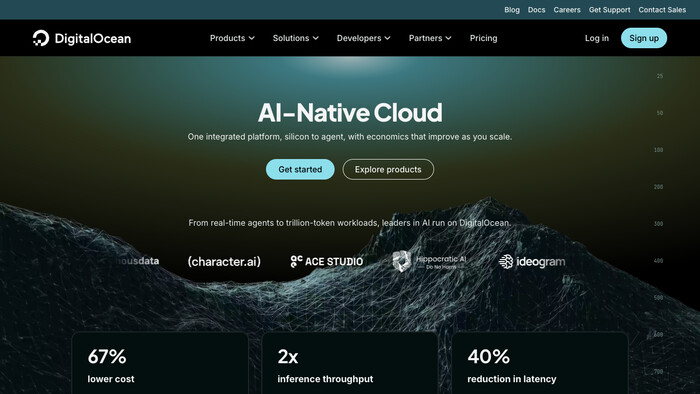

DigitalOcean is a cloud infrastructure provider founded in 2012, oriented primarily toward developers, startups, and small-to-medium-sized businesses. The company operates as a remote-first organization and maintains data centers across multiple regions, with locations in the United States, Europe, Canada, and the Asia-Pacific area. The platform holds SOC 2 and SOC 3 certifications, among others, and is described as supporting workloads subject to frameworks such as HIPAA and DORA. A 99.99% uptime SLA applies to its core infrastructure services.
The foundational compute product is the Droplet, a Linux-based virtual machine available in shared and dedicated CPU configurations with locally attached SSD storage. Droplets support a range of Linux distributions as well as custom images. Beyond individual virtual machines, DigitalOcean offers managed Kubernetes (DOKS), which is CNCF-certified and includes a high-availability control plane. For workloads that do not require persistent infrastructure, there is Functions, a serverless computing option, and App Platform, a fully managed PaaS that supports git-based deployment workflows and container image sources.
DigitalOcean's Gradient AI Inference Cloud is the company's line of services for artificial intelligence and machine learning workloads. It includes GPU Droplets with NVIDIA and AMD GPUs, Bare Metal GPU offerings providing single-tenant access, and preconfigured models for rapid deployment. The Gradient AI Platform provides tools for building AI applications, including support for custom data sources, function execution, evaluation workflows, and versioning, as well as serverless inference through a unified API. Cloudways, a managed hosting product within the DigitalOcean portfolio, is focused on WordPress and PHP-based applications, offering managed deployment and hosting capabilities.
Storage on DigitalOcean is split across three types: object storage (Spaces), which is S3-compatible and includes CDN functionality; block storage (Volumes), attachable to Droplets or Kubernetes clusters; and file storage for shared workloads. The platform also provides automated backups for Droplets and on-demand snapshots. For managed databases, DigitalOcean supports several engines including PostgreSQL, MySQL, and MongoDB, along with Kafka, Valkey, and OpenSearch.
Networking services include load balancing, Virtual Private Cloud (VPC), cloud firewalls, DNS management, and DDoS protection. Infrastructure can be managed through a web-based control panel, a RESTful API, a command-line interface, and integrations with tools such as Terraform. DigitalOcean offers tiered support plans, from a free Starter tier included with every account through to higher-tier plans with faster response times.
| Virtual server | Storage | CPU | Memory | Network | Countries | Options | Price |
|---|---|---|---|---|---|---|---|
| 512 MB 1 CPU Basic Regular |
10 GB
SSD
|
1 2 GHz | 0.5 GB |
0.5 TB
1 000 Mbit/s
|
|
4 | |
| 1 GB 1 CPU Basic Regular |
25 GB
SSD
|
1 2 GHz | 1 GB |
1 TB
1 000 Mbit/s
|
|
6 | |
| 1 GB 1 CPU Basic Premium Intel |
35 GB
NVMe
|
1 2 GHz | 1 GB |
1 TB
1 000 Mbit/s
|
|
8 | |
| 2 GB 1 CPU Basic Regular |
50 GB
SSD
|
1 2 GHz | 2 GB |
2 TB
1 000 Mbit/s
|
|
12 | |
| 2 GB 1 CPU Basic Premium Intel |
70 GB
NVMe
|
1 2 GHz | 2 GB |
2 TB
1 000 Mbit/s
|
|
16 | |
| 2 GB 2 CPU Basic Regular |
60 GB
SSD
|
2 2 GHz | 2 GB |
3 TB
1 000 Mbit/s
|
|
18 |
